ATP and its uses
By Sudhamsh
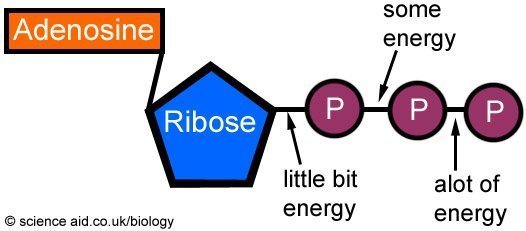
ATP stands for Adenosine Triphosphate. What you need to know from that is that it has 3 phosphates and they store energy. ATP is the high-energy molecule we need to do anything in our lives. ATP is the scientific term, but energy stands for the same thing.
Main ideas :
- Needed to function in any living body.
- It is a nucleotide.
- Energy stored in between the phosphates.
- Used for mostly ALL the processes that take place in a cell.
- Produced by cellular respiration in the mitochondria.
- They are found in plant and animal cells.

Summary : It is considered as the universal energy currency for life. It is not only good for storing energy. It also releases energy so the cells can make good use of it. This is done by enzymes breaking the chemical bonds in between the phosphates. When an enzymes break a single ATP molecule, what remains is ADP, which is one less phosphate. But, when that bond breaks, it is at the moment when energy is released for usage. One of the good things about ATP is that it allows for muscle contraction and movement and the amount of mitochondria in a cell depend on its usage so the ATP would not be wasted for a cell that doesn't need much energy. An important thing is to note that ATP is also created in plants because most people think that mitochondria doesn't necessarily exist in plants. So, do not get confused with that. Both plant AND animals have ATP synthesis. When a person runs a mile and he gasps for breath, and he tries to run again, his legs are sore. That is because more ATP (energy) is created when you have oxygen. But, since he was running, he could not get oxygen and could not create energy to run. In conclusion, ATP is an energy source that is ABSOLUTELY required for all cellular activities.
Sources : http://www2.sluh.org/bioweb/bi100/tutorials/respiration.htm
http://hyperphysics.phy-astr.gsu.edu/hbase/Biology/atp.html

What happens if there's no ATP for plants and animal cells?
ReplyDeleteThat question depends on what cells you are talking about such as root cells, or leaf cells. But, either way that only happens when ATP is not needed for that particular type of cell. ATP is not this type of air that you can get out of thin air. That is what you are confusing yourself with. You get ATP by breaking bonds between phosphate groups. So, suppose a hair cell was in existence. Then, assume we need it to contract. But, it is even not the right concept to think of. A hair cell does not need ATP because we do not want hair to have movement. So, that is when it needs VERY VERY little amounts of ATP. Also, you are forgetting that ATP is created using mitochondria. So, what you are asking me that what if there was no mitochondria? That is a case where it proves that organism is a prokaryote. Prokaryotes have other means of energy creation instead of mitochondria because they lack membrane-bound organelles. In a single sentence to wrap this up, there would never be a case where you RUN OUT of ATP which just means there is no mitochondria. I anticipate that this answer cleared your doubt, Josh.
DeleteWhere is ATP specifically found in nucleic acids? Very good job on explaining the uses of ATP.
ReplyDeleteIs ATP its own source of energy or is there another power that ATP get its energy from?
ReplyDelete