Friday, April 14, 2017

Codominance

Codominance 
Codominance is a pattern in Non-Mendilian genetics. It is when no single allele is dominant over the other, both are present at the same time. 

  • There are two dominant alleles, neither allele over powers the other
  • Both alleles will be capital letters 
  • Alleles can be represented as primes or letters. Ex: Black fur on a cat and White fur on a cat. They are both dominant but you can choose the alleles as being BW or BB' 
  • Codominance shows a combination of both of the traits like spotted, stripped, checkered, etc.


Example Chart: 


Microscope Parts and Types

By: Elizabeth Cook


    The microscope is a tool that is used in a lab to view very small (microscopic) objects. There are many different types of microscopes, but they all have the same purpose.

    There are three different categories of microscopes, the electron, compound and the compound light microscope. The compound microscope is commonly used for about 10X magnification, and was invented by Zacharias Janssen. It has two systems of lenses: The ocular/eyepiece lens and the objective lens, which is closest to the object of magnification. The compound light microscope can magnify an object up to 1000X to 2000X the original size. This was also invented by Zacharias Janssen It works by using light to transmit the images to our eyes. The compound/compound light microscopes should always be carried by the base and the eyepiece(see picture below). The electron microscope is used for maximum magnification, which can go up to about 10,000,000X the original size. This microscope works by scanning a focused electron beam over a surface to create an image. The electrons then react with the object of magnification and produce the images. The electron microscope was invented by Ernst Ruska and Max Knoll. It is also much larger than the other microscope types.

    Microscopes are very useful in all labs and are a major key in new discovery. Without microscopes, we would not be able to view microscopic objects and we wouldn't know as much as we do about other organisms.

Citations: 
http://www.cas.miamioh.edu/mbi-ws/microscopes/compoundscope.html
http://www.explainthatstuff.com/electronmicroscopes.html
The Compound Microscope


The Electron Microscope

Thursday, April 13, 2017

Nitrogen Cycle


Nitrogen Cycle
By: Joshua Miller


The Nitrogen Cycle is when nitrogen moves between the atmosphere, biosphere, and geosphere in different forms.  It is a biogeochemical cycle by which nitrogen is converted into various chemical
forms as it circulates. The conversion of nitrogen can be carried out through both biological and physical processes.  Even though most of the air we breathe is N2, most of the nitrogen in the air is not available for use by organisms because it is relatively unreactive; whereas, organisms need reactive nitrogen to be able to bring it into cells.  For plants and animals to be able to use nitrogen, N2 gas is first converted to a more chemically available form   

There are five main processes that cycle nitrogen through the geosphere, atmosphere, and biosphere.  They are nitrogen fixation,  nitrogen uptake through organismal growth, nitrogen mineralization through decay, nitrification, and denitrification.    Microorganisms like bacteria play a major role in all of the main nitrogen transformations.  

Since atmospheric nitrogen has limited availability for biological use, usable nitrogen is scarce in many types of ecosystems.  Ecologists find the nitrogen cycle interesting because nitrogen availability can affect the rate of certain ecosystem processes such as decomposition.  The human activities of fossil fuel combustion, use of artificial nitrogen fertilizers, and the release of nitrogen in wastewater have dramatically altered the global nitrogen cycle.  


In summary, most nitrogen in the air cannot be used by organisms because it is unreactice.  For plants and animals to be able to use nitrogen, it must first be converted to a more chemically available form. I found it interesting, but I am not surprised, that human activities can affect the way the nitrogen cycle works.  


https://en.wikipedia.org/wiki/Nitrogen_cycle
http://www.visionlearning.com/en/library/Earth-Science/6/The-Nitrogen-Cycle/98

Chloroplast

                                                 Chloroplast
                                           By:Khalilah Morris

Chloroplast is the organelles that capture the energy from sunlight and convert it into chemical energy in a process called photosynthesis. It is the primary pigment in photosynthetic plants.


                                                       Main Idea:
Works to convert light energy of the sun into sugar that can be used by cells.The entire process is called photosynthesis and it all depends on the little green chlorophyll molecules in each chloroplast.A green pigment in chloroplasts called Chlorophyll absorbs the energy in sunlight.This energy is used to convert carbon dioxide and water into glucose and oxygen.

                                                          Summary:
Chloroplasts contain chlorophyll. This is a green pigment that absorbs light energy from the sun for photosynthesis. Photosynthesis occurs in two stages, the light reaction stage and the dark reaction stage. The chemical energy produced from this process is stored as sugar. Chloroplasts are plastids that develop in the cells of plant leaves. Plastids assist in the process of storing and later harvesting needed substances to produce energy. Chloroplasts contain the following structures: membrane envelope, thylakoid membrane and chlorophyll.


Citations: http://study.com/academy/lesson/what-is-granum-definition-function.html
http://www.biology4kids.com/files/cell_chloroplast.html-
https://www.slideshare.net/GregScrivin/chloroplast-

acid rain

•acid rain can also produce from volcanic eruptions.

•It cannot rot your skin.

•the acid in the rain can damage car paint.

•entire lakes have been declared dead due to acid rain.

Vacuoles

Cell Organelles: Vacuole

The vacuole is a membrane-bound organelle that exists in plant cells and animal cells. Their main function is to store waste and water. 

Main Points

  • They exist in both plant and animal cells.
  • Vacuoles can take up to 90% of a cell's volume, but at the very least 30%.
  • Their main function is process and store the waste products of the cell. 
  • The vacuole is membrane bound 
Summary

The vacuole is a waste faculty for water and any other waste products. It can take up most of the cell depending on how much waste is in the cell. The vacuole is very important because if it wasn't for the vacuole the cell would be consumed by waste and water. 


Citations
https://www.nature.com/subjects/vacuole
https://www.nature.com/scitable/topicpage/plant-cells-chloroplasts-and-cell-walls-14053956
http://bscb.org/learning-resources/softcell-e-learning/vacuole-plants/

Genetics Dominant Trait

Image result for what are dominant traits 


Genetics : Dominant Trait 

Jacey Robustelli

Genetics are the study of heredity. Most of your knowledge came from the work of Gregor Mendel. He was born in 1822. Mendel was a Monk and School teacher. He liked to Monastery garden. He became very interested in pea plants. In his studies he came up with different generations called P1 (First Parents), F1 (First Filial), F2 (Second Filial). The offspring of P1 were called the F1 generation and the offspring of F1 were called the F2 generation. 

In the P1 generation both alleles would always be homozygous. But how would you tell the difference. Well Mendel came up with dominant and recessive. If something was dominant one gene blocked out the other pair. When something is recessive it is the blocked gene. 

For example dark hair is a dominant trait for humans. If one parent has the gene for dark hair and the other has the gene for light hair the child will have dark hair. All of your traits are chosen by whether or not they are dominant or recessive. Because dominant is always going to overrule recessive.  

Source: https://www.education.com/science-fair/article/biology_it-takes/

ATP And Its Uses


ATP and its uses
By Sudhamsh

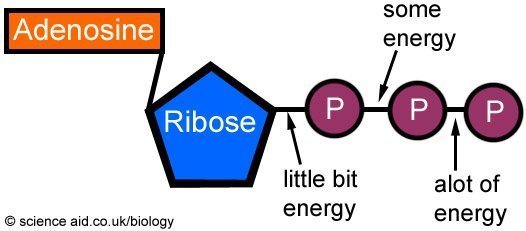
ATP stands for Adenosine Triphosphate. What you need to know from that is that it has 3 phosphates and they store energy. ATP is the high-energy molecule we need to do anything in our lives. ATP is the scientific term, but energy stands for the same thing.

Main ideas :
  1. Needed to function in any living body.
  2. It is a nucleotide.
  3. Energy stored in between the phosphates.
  4. Used for mostly ALL the processes that take place in a cell.
  5. Produced by cellular respiration in the mitochondria.
  6. They are found in plant and animal cells.

Summary : It is considered as the universal energy currency for life. It is not only good for storing energy. It also releases energy so the cells can make good use of it. This is done by enzymes breaking the chemical bonds in between the phosphates. When an enzymes break a single ATP molecule, what remains is ADP, which is one less phosphate. But, when that bond breaks, it is at the moment when energy is released for usage. One of the good things about ATP is that it allows for muscle contraction and movement and the amount of mitochondria in a cell depend on its usage so the ATP would not be wasted for a cell that doesn't need much energy. An important thing is to note that ATP is also created in plants because most people think that mitochondria doesn't necessarily exist in plants. So, do not get confused with that. Both plant AND animals have ATP synthesis. When a person runs a mile and he gasps for breath, and he tries to run again, his legs are sore. That is because more ATP (energy) is created when you have oxygen. But, since he was running, he could not get oxygen and could not create energy to run. In conclusion, ATP is an energy source that is ABSOLUTELY required for all cellular activities.

Sources : http://www2.sluh.org/bioweb/bi100/tutorials/respiration.htm
http://hyperphysics.phy-astr.gsu.edu/hbase/Biology/atp.html

Wednesday, April 12, 2017

Mutation Deletion

Mutation Deletion in DNA
By: Blake Noble

Deletion:
Deletion is a mutation in the chromosome sequence in DNA. Deletion happens when a molecule of DNA failed to be copied during the replication process. 

Nucleotides are units of DNA that consists of deoxyribose (a sugar), phosphate group, and a nitrogen base.

Each molecule in the DNA has two strands. For example, in the original DNA strand there is cytosine, and on the complementary strand, there is Guanine. These both will pair together just like how Adenine pairs with Thymine. These are called base pairs. ex) A always pairs with T, and G always pairs with C.  Same is applied in reverse.


An example of this mutation is depicted below. 


As you can see each pair then create codons of three that each code for a certain Amino Acid. In the mutation of deletion, if one and/or more of the molecules (as stated before) fails to be paired in the replication process, it could potentially throw off the rest of the process and cause severe diseases. 


Sunday, April 9, 2017

Blogger Information

Hey Everyone! Here is the information for your quarter long project that you will be working on.

Quarter Project


Throughout the remainder of the semester you will be updating blog posts and commenting on classmates blogs with questions. The goal of this assignment is to research areas of the curriculum and create interactive reviews that can then be used as a study guide before the EOC. It is the responsibility of the owner to monitor their blog and answer any questions posted by classmates.


Everyone will make three blog posts and comment on 3 other students posts per each blog due date totaling 9 comments/questions (meaning you cannot comment on the first 9 blogs and be done for the semester). In total you will make 3 blogs with 9 comments. Each blog should contain a visual (picture, video, animation), main ideas/information about your topic (Something you can use as a quick review before the EOC), and some type of reflection (a summary of what you learned, what surprised you, was this something you already knew about, how did you like this objective, how can it be applied outside of biology, ect). Go to the following link to sign up for your topics: https://docs.google.com/document/d/1egOHY4ggEfTNKogGEqr7_H8Gssy9l299oGCDD9cP9dU/edit?usp=sharing. All topics must be picked once before a second person can sign up for them. I have put some notes in parenthesis by a few topics to help narrow the topic. MAKE SURE YOU PUT YOUR NAME IN YOUR BLOG AND THE COMMENT SO I CAN GIVE YOU CREDIT FOR THE ASSIGNMENT.


Your blog post might be due before we cover the content objective in class. If your objective has not been covered you will need to do some research on your own, but always know I will be available to help guide and narrow your research if needed.


DO NOT contact me the day before your post is due asking for help narrowing your research. You have plenty of time so plan ahead.


The first blog will be due by MIDNIGHT Friday April 14th.
-All questions must be asked by MIDNIGHT Friday April 28th.
The second blog will be due by MIDNIGHT Friday May 5th.
-All questions must be asked by MIDNIGHT Friday May 12th.
The third blog will be due by MIDNIGHT Friday May 19th.
-All questions must be asked MIDNIGHT Friday May 26th.